Multics: Generative Multi-Player World Model with Hierarchical Communication
1The University of Hong Kong 2ARC Lab, Tencent IEG
01 — Key Features
One shared world.
Many independent players.
TL;DR Multics enables robust multi-player video generation with cross-player consistency, player-specific controllability, reducing interference between unrelated events and scales from 4-player training to 10-player inference without retraining.
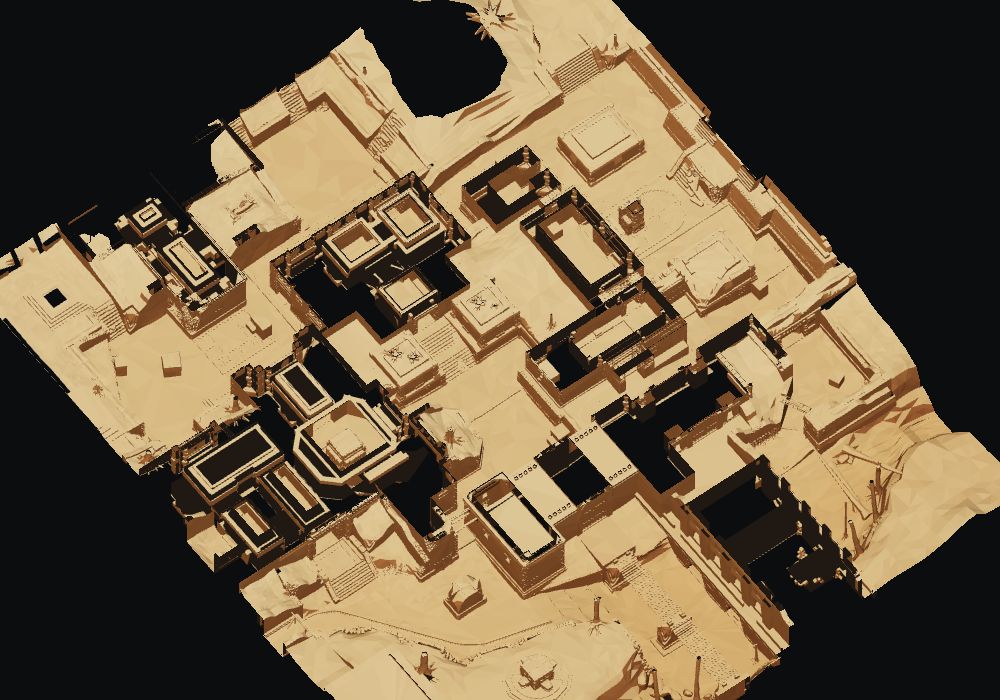
Recorded gameplay illustrating the multi-player setting. Map shown for visualization only.
Our advantages
Cross-player consistency, player-specific controllability, and interference robustness.
Supports 6, 8, and 10 players without retraining, with lower self-attention cost.
02 — Method
Communication, at the right level.
Given each player’s initial view, text prompt, actions, and camera trajectory, Multics jointly generates videos of a shared environment, keeping overlapping views consistent while following each player’s controls.

Hierarchical communication
Player → group → global exchange limits direct mixing between unrelated events.
Shared group tokens
Exchangeable group slots support varying player counts without new parameters.
Dynamic grouping
Recent camera trajectories organize relevant players under a fixed budget.
03 — Robust multi-player video generation
Comparison: Cross-Player Consistency
The six-player comparison is not available yet.
Shared scene details and visible players should remain consistent across overlapping views.
01 / 02Comparison: Player-Specific Controllability
The six-player comparison is not available yet.
Each player should follow their own action and camera controls, independently of other players.
01 / 02Comparison: Interference Robustness
The six-player comparison is not available yet.
Unrelated events in one player’s view should not alter another player’s scene or actions.
01 / 0204 — Scalability
Train with four. Infer with six / eight / ten.
Computational efficiency
Structured communication changes the scaling curve.
Hierarchical communication achieves computational efficiency comparable to centralized communication. At 10 players, Multics reduces DiT latency by 61.9%, self-attention latency by 78.1%, and self-attention FLOPs by 86.1% compared with fully-connected communication.
05 — More results
More multi-player generation videos.
Each view follows its own controls.
All views play in sync with keyboard and mouse inputs.
6 players
Multics · 6 simultaneous viewsPlayer 1
Keyboard
Mouse
Loading controls…
Player 2
Keyboard
Mouse
Loading controls…
Player 3
Keyboard
Mouse
Loading controls…
Player 4
Keyboard
Mouse
Loading controls…
Player 5
Keyboard
Mouse
Loading controls…
Player 6
Keyboard
Mouse
Loading controls…
8 players
Multics · 8 simultaneous viewsPlayer 1
Keyboard
Mouse
Loading controls…
Player 2
Keyboard
Mouse
Loading controls…
Player 3
Keyboard
Mouse
Loading controls…
Player 4
Keyboard
Mouse
Loading controls…
Player 5
Keyboard
Mouse
Loading controls…
Player 6
Keyboard
Mouse
Loading controls…
Player 7
Keyboard
Mouse
Loading controls…
Player 8
Keyboard
Mouse
Loading controls…
10 players
Multics · 10 simultaneous viewsPlayer 1
Keyboard
Mouse
Loading controls…
Player 2
Keyboard
Mouse
Loading controls…
Player 3
Keyboard
Mouse
Loading controls…
Player 4
Keyboard
Mouse
Loading controls…
Player 5
Keyboard
Mouse
Loading controls…
Player 6
Keyboard
Mouse
Loading controls…
Player 7
Keyboard
Mouse
Loading controls…
Player 8
Keyboard
Mouse
Loading controls…
Player 9
Keyboard
Mouse
Loading controls…
Player 10
Keyboard
Mouse
Loading controls…
KeyboardWASD move · Space jump · Shift walk · Ctrl crouch · R reload · E interact. Attack is the primary weapon input: shoot, melee, or hold a grenade ready to throw. Secondary is the weapon’s secondary input. Switch lights on a weapon change; hover for the target class.
MouseThe dot shows turn/look direction; Δ yaw and pitch show each frame’s rotation. Yaw and pitch show the view orientation. Highlights indicate recorded inputs, rather than successful in-game effects.
06 — Abstract
Multi-player interactive world models aim to simulate shared environments from multiple players’ perspectives, but achieving robust generation while scaling to more players remains challenging. Existing approaches that rely on fully-connected communication (e.g., Solaris) incur quadratic attention costs as the number of players grows, while centralized approaches (e.g., γ-World) suffer from interference between unrelated events in a shared global representation. To address these challenges, we present Multics, a multi-player video generation framework with hierarchical communication that structures information exchange across player, group, and global levels. This hierarchy introduces group tokens into self-attention as intermediate group-level representations that aggregate locally relevant player information. These tokens connect to global tokens for cross-group communication, while the hierarchical topology limits direct mixing between unrelated local events. Group-token parameters are shared across group slots, allowing the same communication module to accommodate varying numbers of players without introducing new group-specific parameters. We further propose budget-constrained dynamic grouping based on recent camera trajectories, which adaptively groups relevant players while limiting unnecessary communication. Experiments demonstrate that Multics achieves state-of-the-art performance in 4- and 6-player settings, with improved cross-player consistency, player-specific action and camera controllability, and interference robustness. Moreover, Multics generalizes from 4-player training to 6-, 8-, and 10-player inference without retraining, while reducing self-attention computation compared with fully-connected communication.
07 — Citation
@article{huang2026multics,
  title   = {Multics: Generative Multi-Player World Model
             with Hierarchical Communication},
  author  = {Huang, Kaiyi and Yu, Wangbo and Huang, Yukun and
             Yu, Jiwen and Liu, Kunhao and Yang, Donglin and
             Hu, Wenbo and Shan, Ying and Liu, Xihui},
  journal = {arXiv preprint},
  year    = {2026}
}